



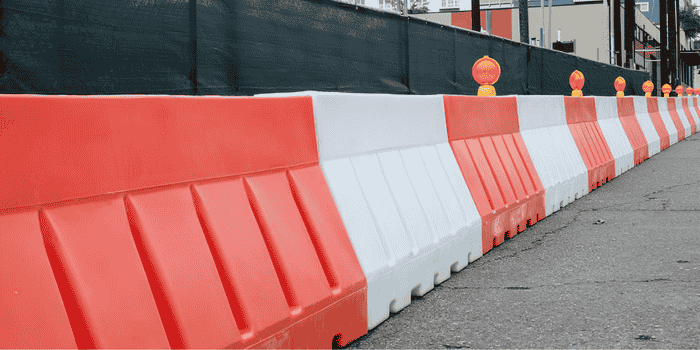
In the field of civil engineering and large-scale site management, the physical weight of a security system is often its most valuable attribute. To ensure maximum protection against vehicular impact and unauthorized site entry, project managers must strictly adhere to industry-standard jersey barrier dimensions when planning their perimeters. These concrete monoliths are designed with a specific sloping geometry that prevents vehicles from crossing into work zones, instead redirecting them back onto the roadway. By understanding the precise footprint and height of these units, logistics companies can accurately calculate the necessary transport requirements and placement strategies for high-risk infrastructure projects.
The Engineering Behind the Profile
The effectiveness of a Jersey barrier is rooted in its unique “Type 1” or “F-Shape” profile. Typically, a standard 8-foot unit stands 32 inches tall with a wide base that tapers toward the top. This design is not merely for stability; the sloped face is engineered to engage with a vehicle’s tires before the body of the car strikes the concrete. This minimizes damage to the vehicle while preventing it from vaulting over the barrier into a construction zone or an oncoming lane of traffic.
For government and municipal agencies, using standardized dimensions is critical for interoperability. When barriers meet universal size specifications, they can be seamlessly linked to existing municipal stock or rented units from various suppliers. This modularity allows for the creation of miles of continuous, unbreakable protection along highways and around critical government buildings.
Logistical Planning for Heavy-Duty Hardware
Because a single 8-foot concrete barrier can weigh upwards of 4,000 pounds, spatial planning is essential. Security firms must account for the 24-inch base width when defining pedestrian walkways or staging heavy machinery. Accurate measurements ensure that the barriers provide a tight seal around the work zone without infringing on necessary operational space.
These barriers are also equipped with specialized lifting points—usually recessed holes or steel loops—that allow for placement via crane or heavy-duty forklift. Understanding the weight-to-dimension ratio is vital for ensuring that the onsite equipment is rated to handle the installation process safely and efficiently.
Versatility in Extreme Environments
While their primary home is the highway, these barriers are increasingly utilized by event planners for high-profile public gatherings. In an era where vehicle-ramming attacks are a concern for venue security, the massive mass of a concrete barrier provides a level of “anti-terror” protection that plastic or light metal systems simply cannot offer. They are often used to create “hard perimeters” around stadium entrances, outdoor festivals, and holiday markets, providing peace of mind for both organizers and attendees.
Conclusion
Selecting the right perimeter hardware requires a balance of technical knowledge and practical application. Whether you are managing a bridge repair project or securing a major metropolitan event, the physical presence of concrete reinforcement is the ultimate deterrent. For professionals who require precision-engineered safety solutions that meet all federal and local specifications, Epic Crowd Control provides the heavy-duty equipment necessary to fortify any site against the most demanding challenges.
